Showing posts with label baseball 101. Show all posts

Thursday, June 13, 2013

Baseball 601 (Or whatever I said I'd call this)

So almost two months ago, the good folks here at 162+ put together a baseball glossary of sorts.  You know...the stuff we reference all the time and assume you know, but you might actually not know.  Like 5-4-3 double plays, 5-tool players, and Leo's personal favorite Ducks on the Pond.

In case you forgot...
Well...that wasn't even half of it.  So...here we are again.  Baseball 601 - I think that's what I called the "advanced" version of the glossary when I ended the last one.  Here we go...get your spikes on:

Save Situation - There are a couple of rules here.  To qualify as a save situation, the pitcher in the save situation must enter the game later, in other words, he cannot be the starter or the winning pitcher.  It doesn't have to be the 9th inning, it can be the 8th, or even the 7th, etc.  BUT, he MUST obviously record at least one out.  Also one of the following must apply:

1.  His team cannot have a lead of more than three runs when he enters the game.
2.  He enters the game with the tying run either on base, at bat, or on deck.  Regardless of the count when he enters the game.
3.  He pitches for at least three innings.

That was a long explanation wasn't it.  I told you this was the advanced class.  Now, before you start name-calling, nobody here is a Yankees fan.  I swear.  But, you can't define save without this dude's picture:

Oh that cutter.
The dude does have SIX HUNDRED THIRTY ONE saves after all.  And he's STILL pitching...going on his 51st season.

Hold.  So what about the guy that comes in before the closer?  To get a 'hold', almost everything is the same as with a save situation, except, the reliever only qualifies for a hold if he leaves before the game ends and doesn't give up the lead.  Thereby "holding" the lead for the closer.

WHIP.  We covered ERA last go round, which is the number of earned runs a pitcher gives up in an average nine innings.  Well, WHIP is another pitching sabermetric that basically gives you a measure of a pitcher's ability to keep hitters off the bases.  It is walks + hits per inning pitched.  How many baserunners, of any kind, does this guy allow per inning on average?  

Alright...enough with the pitchers.  Let's talk hitting.

On Deck.  This is just the guy next in line to come up to bat.  There's an "on deck circle" that is this guy's place to stand until he's up...but they rarely stand IN the circle.  They mill around, take swings, etc.   My favorite on deck story involved Pudge Rodriguez.  As most of my favorite stories of any kind do.  He was once in the on deck circle for like 7 extra minutes because he was attempting to take the donut off the fat part of the bat.  The broadcasters were dying laughing.  I didn't say he was smart.  I said he was a GREAT ballplayer.  Sadly, I can't find a picture of this.  But, at least I'll show the on deck circle:

Kitten Face on deck and outside the circle.
And, as you can see, there's NO WAY to get that donut off the fat end of that bat.
In the hole.  Do NOT say "That's what she said".  Just don't. This is the guy that's hitting after the guy who's on deck.  He usually parks himself on the top step of the dug out until it's his turn to move into the on deck circle.   

Slugging Percentage.  (SP) We know that Batting Average tells us how often a guy gets a hit; hits divided by at bats.  Well, Slugging Percentage is a measurement of power.  Total bases divided by at bats, with each multi-base hit getting multiplied by the number of bases the hitter got at that time; a single is one base, a double is two bases, and so on...then you divide the sum of all of that by the number of at bats:

SLG = (1B) +  (2 X 2B) + (3 X 3B) + (4 X HR)/AB          


Let's up the ante now.

On Base Average.  (OBA) Exactly what it sounds like.  A measurement of how often a hitter is on base by almost any means; hits, walks, and even hit by pitch.  (almost because it doesn't include when a runner is on because of errors, or fluke stuff like catcher's interference).  Take the sum of all of those and divide them by the sum of hits, walks, hit by pitch, and sacrifice flies.  Sac bunts don't count because they are considered strategic.  That'll give you a pretty good idea of how often a guy is on base.

I'll see your OBA and raise you a:

OPS.  On Base Plus Slugging.  Also exactly what it sounds like, the combo of Slugging Percentage and On Base Average.  This just gives you a great idea of how well a guy gets on base AND hits for power.  

The OPS king*.  (Yes, he also get asterisks from 162+)
Hit & Run.  This is a risky offensive strategy involving the guy on base and the guy at bat.  The thought process is that if the guy on base attempts to steal a base, it'll open a hole between the bases for the hitter to put the ball through.  The reward if you succeed?  A two base advancement or even a run scored, depending on which base the base stealer was originally on.  The risk if you fail?  The strike 'em out, throw 'em out double play.  

Fielder's Choice.  For the 3rd time, I will say...exactly what it sounds like.  If a guy is on base and the batter hits a ground ball to an infielder, the infielder can choose to throw to first to get the hitter.  OR, he can choose to try to get the lead runner (the guy that was already on base) out instead.  The at bat for the hitter is scored as a Fielder's Choice and even if the hitter's now on first base (because the infielder chose to get the lead runner out), he is not credited with a hit.  

And now for the RULES.  

The game of baseball is over 160 years old.  I think we covered that.  Part of being that old is having about 35248412318454 rules.  I'm going to venture to say that baseball has the most complex rules of any professional American sport.  I mean...this blog post could go on for days just on rules.  But don't worry, it's not nap time yet.  We're just gonna hit three.  But, just in case you thought I was kidding...click here (and that's not even all of it).

Defensive Indifference.  Super simple.  If a guy steals a base and no gives a crap on the other team...BAM...defensive indifference.  It's usually really easy to pick this one out because the catcher will barely even look at the runner and will definitely make no attempt to throw him out.  In this case, the runner is NOT credited with a stolen base.  And this usually happens in blowout games because the stolen base and the run it could help produce, doesn't really matter in the outcome of the game.

Catcher's Interference.  After about 20 years of this never happening, it's been called...like...5 times  in the last couple of years.  Ask Leo.  I'm not making that up.  Basically, the catcher is not allowed to make any contact with the batter, not him nor his equipment.  Interference is usually called when the catcher's mitt makes contact with the hitter's bat.  It  normally happens when the catcher gets overzealous about throwing a guy out attempting to steal a base and he gets up too soon, but that's not always the case.  The result is that the hitter is awarded first base (with no official at bat) and the catcher is charged with an error.  The caveat is if the hitter still manages to get a hit after his bat hits the catcher's mitt, the umpire can wave off the interference call.  

And now...I present to you...the granddaddy of all rules:

The Infield Fly Rule.  I'm deeming this one the granddaddy because Leo and I have decided that only roughly 3-5% of a sold out Rangers Ballpark in Arlington can explain this one to you.  And I still think we're being generous.  I mean that's about 2400 people...I don't buy that.

Anywho...here it goes.  The point of the rule is to prevent an infielder from intentionally dropping a routine pop up so that he can easily double up or even triple up (!) runners already on base.  This is multiple runners.  If there's only a guy on first, the infield fly rule will not be invoked because it's not really advantageous for the infielder if he chose to intentionally drop the pop up.

When the rule is invoked by the umpire, he'll do this:

I got it!  I got it!
And that signal means the rule is in affect and no matter what the fielder does, the hitter is out and no one on the bases can be forced out.  The runners can attempt to tag up like they would with a fly ball, but that's at their own risk just like a regular tag.  And they almost never do that because...well..because the guy with the ball is RIGHT THERE.  

So what's the big deal?  That's easy to understand.  Well...the difficulty comes in when discussing when the rule can be invoked.  This is totally at the umpire's discretion.  There's no point on the field where it cannot be called.  The only guidelines are that the ball must be "catchable" with "ordinary effort" by an infielder, which is totally subjective.  

Last year during the Cardinals/Braves Wild Card playoff game, umpire Sam Holbrook made a really late infield fly call on a ball that was hit into the outfield, practically, by the Braves' Andrelton Simmons.  And at the time, the Braves had men on first and second with one out in the 8th.  They were also down by three runs. Well, the infield fly call meant that Simmons was automatically out and the runners couldn't advance, EVEN THOUGH no Cardinals player caught the ball.  Short story long, the Braves lost that game and their playoffs and Chipper Jones' career were over.  You make the call:
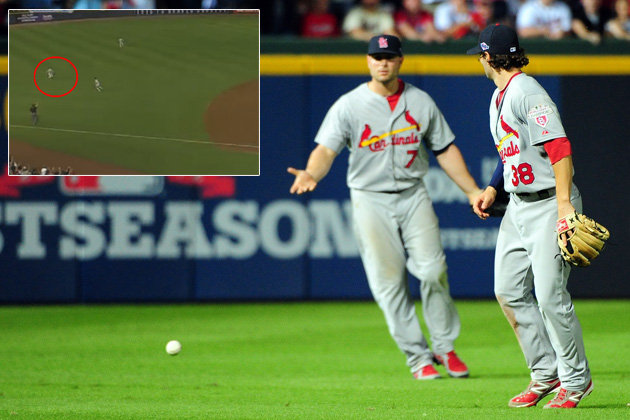
That ain't "ordinary effort".
Ok class...time for summer break, that was a lot to take in.  Stay tuned for more on other fun topics like the Rule 5 Draft, Minor League Contracts, and more in your graduate course coming later this summer.

38 Wins, 27 losses.  1 game back of Oakland.  

On the bright side, it's Yuesday and Kins is rehabbing in Frisco tonight.  


Monday, April 15, 2013

5-4-3? What Does That Mean?


As a teenager (I was about 14-ish, I think), I sat on the edge of my bed and watched Ken Burns’ baseball every night for nine innings.  That’s how he broke up the documentary, into nine episodes that he called innings, keeping on topic.  And even then I thought to myself, “I’m the only person I know doing this right now, aren’t I?” and I was; definitely the only person my age and gender.  But I hardly cared…I found the history of the game fascinating…

My boy band consisted of Cy Young, Honus Wagner, Shoeless Joe,
Joltin' Joe (he was the heartthrob), and Roberto Clemente. 
NOT TO FEAR!  I am not gonna go Ken Burns on you.  I just brought it up to say that some baseball terminology is over 100 years old, literally.  And so, some of it makes no sense.  It may have in 1890, not so much in 2013.  

Before I forget, here's a link to the Ken Burns' Baseball DVDs if you’re interested, I swear it’s worth your time. 

What I AM gonna do though, is get you up-to-speed on what the hell we’re talking about here at 162+, because we sometimes have a tendency to assume you know what a 5-4-3 DP is…and other fun terms. 

And without further ado...

Here are some basic terms and abbreviations based on baseball’s scoring system, meaning how the “official scorer” records different happenings throughout the course of the game:

K – Strike out

Backwards K – Strike out looking

It's actually a backward K though; not the words "backward K" Haha.

IP - Innings Pitched

ERA – Earned Run Average – The average number of runs a pitcher gives up in 9 innings

BB – Walk

IBB – Intentional Walk

HBP - Hit By Pitch

Did Greinke really think he was going to win that fight?
LOB - Left On Base - As in runners left on base without scoring. *Unfortunately Arlington, TX is becoming LOB City*

WP - Wild Pitch – A pitch that travels past the catcher, due to the pitcher throwing it too high, wide, or in the dirt, allowing base runner(s) to advance to the next base.

PB -  Passed Ball – Also a pitch that gets away from a catcher allowing base runner(s) to move up, only this time, it’s the catcher’s fault and the official scorer deems that the ball “should” have been handled by the catcher

If you're wondering if it's a WP or PB, ask yourself, "Did Tim Wakefield throw it?"
DP – Double Play – A double play occurs when two outs are recorded on one play

GIDP – Ground Into Double Play *We need to create a tune for this...then it can become a ballpark chant for opposing teams!*

5-4-3 Double Play – Each baseball position is numbered for scoring purposes, like so:


So, 5-4-3 means the ball went from the 3rd baseman (5) to the 2nd baseman (4) to the 1st baseman (3) for the two outs.  And a 6-4-3 double playis translated the same way, with the shortstop (6) replacing the 3rd baseman (5)

Here's different group of terms which consists of popular terms that fans/broadcasters use, which are not necessarily related to official game scoring, but are usually universally recognized among other fans and may be more useful when watching the game:

RISP – Runners In Scoring Position – Base runners on 2nd and/or 3rd base 

Ducks On The Pond - Ditto to the RISP *And the Barry Bonds version (on steroids) of "ducks on the pond" is when the bases are loaded*


Elvis letting the bench know that there are now Ducks On The Pond (circa Summer '11)


This one even got so popular in the Metroplex that they made t-shirts!  You have one, don't you?

Hat Trick – 3 strike outs in one game by a single player

Golden Sombrero – 4 strike outs in one game by a single player

Getaway Game – Last game before a team leaves town; generally a day game

Double-Header – 2 back-to-back games played in one day

Day/Night Double – Header – 2 games in one day, but with more time in between the games than a traditional double-header; usually a 1PM and 7PM start or similar

Can of Corn – An easy to catch fly ball *Here's one of the 100-year old terms I was telling you about*

Hot Corner – 3rd base…because the balls come hard and fast at 3rd base *That’s what she said*

Keystone Combo – The 2nd baseman and shortstop makeup your keystone combo.  The bag at second base is the “keystone” or pinnacle of the field in terms of scoring position or defensive plays and the 2nd baseman and SS both record outs there or work together to turn DPs there. 

My favorite Keystone Combo.  (And by the looks of it, they're each other's favorite too)

Battery – The pitcher and the catcher make up the battery

And here is my favorite "battery" in action.  And, YES, the pun is intended.   Assault and battery?  NO?

Rubber Game/Match – The final and deciding game of a series.  *EX:  If Team A wins game 1 and Team B wins game 2, game 3 of the series is the rubber game*

Texas Leaguer –  This is your classic bloop single; a weekly hit fly ball that falls in between the infielders and outfielders

Baltimore Chop – A ball batted straight into the ground in front of home plate so that it pops up, either above the head of the infielder or so high that the runner has time to run it out for a single.

DFA/DFA’d – Designated For Assignment – This means you’re off the big league roster and the team has to decide what to do with you:  put you back on the roster, trade you, or release you.

  There's a reason he's pictured between "DFA'd" and "Mendoza Line"
Mendoza Line – Anyone with a batting average under .200 is said to be hitting below the “Mendoza Line”. *You’ll be happy to know that this measurement of mediocrity is named for Mario Mendoza, a one-time Texas Ranger*

12-6/Uncle Charlie – There are about 1289795 names for a big breaking curve ball, these are two of them.  12-6 as in you’re looking at a clock and the ball drops (breaks) sharply from 12 to 6.
*Don’task me where Uncle Charlie came from…but, it’s the same thing*

Backdoor Breaking Ball – A breaking pitch of any kind (but usually slider or cutter) that looks like it’s going to miss the strike zone initially, but breaks late laterally to catch the outer edge and back-side (or back door) of the strike zone. *Who can forget this gem from the Rangers broadcast team:  "How do you know when you’ve been back-doored?”*

The Stretch/7th Inning Stretch – This is an old baseball tradition in which fans stand up and “stretch” between the top and the bottom of the 7th inning.  It’s also when the whole ballpark sings “Take Me Out to the Ballgame” *AND the Cotton-Eyed Joe for Rangers fans*
             
                                     
Shut Down Inning  - When a team scores in their half of an inning and allows no runs in the opponent's half of the inning, shutting them down. * Great way to build or maintain momentum in a game*

Cycle – When a player hits a single, double, triple, and home run in one game.  *It's called a "Natural Cycle" when they hit them in that exact order*
                                     
Of course you remember Kins' 6-for-6 cycle night, right?

5-Tool Player
– One that has all of the tools necessary for baseball dominance.  
                     
So what are the “5 Tools”? 

1. Hit for average
2. Hit for power
3. Base running skills
4. Good defender
5. Good throwing arm

If you're bored, Google it...and this will come up:

WHATEVER.
That's all I got for now.  If you found Baseball 101 easy, be sure and sign up for Baseball 601 for more advanced terms like "the infield fly rule" and "catcher's interference"...coming Summer 2013!

13 down, 149.  Bring it, Cubbies!